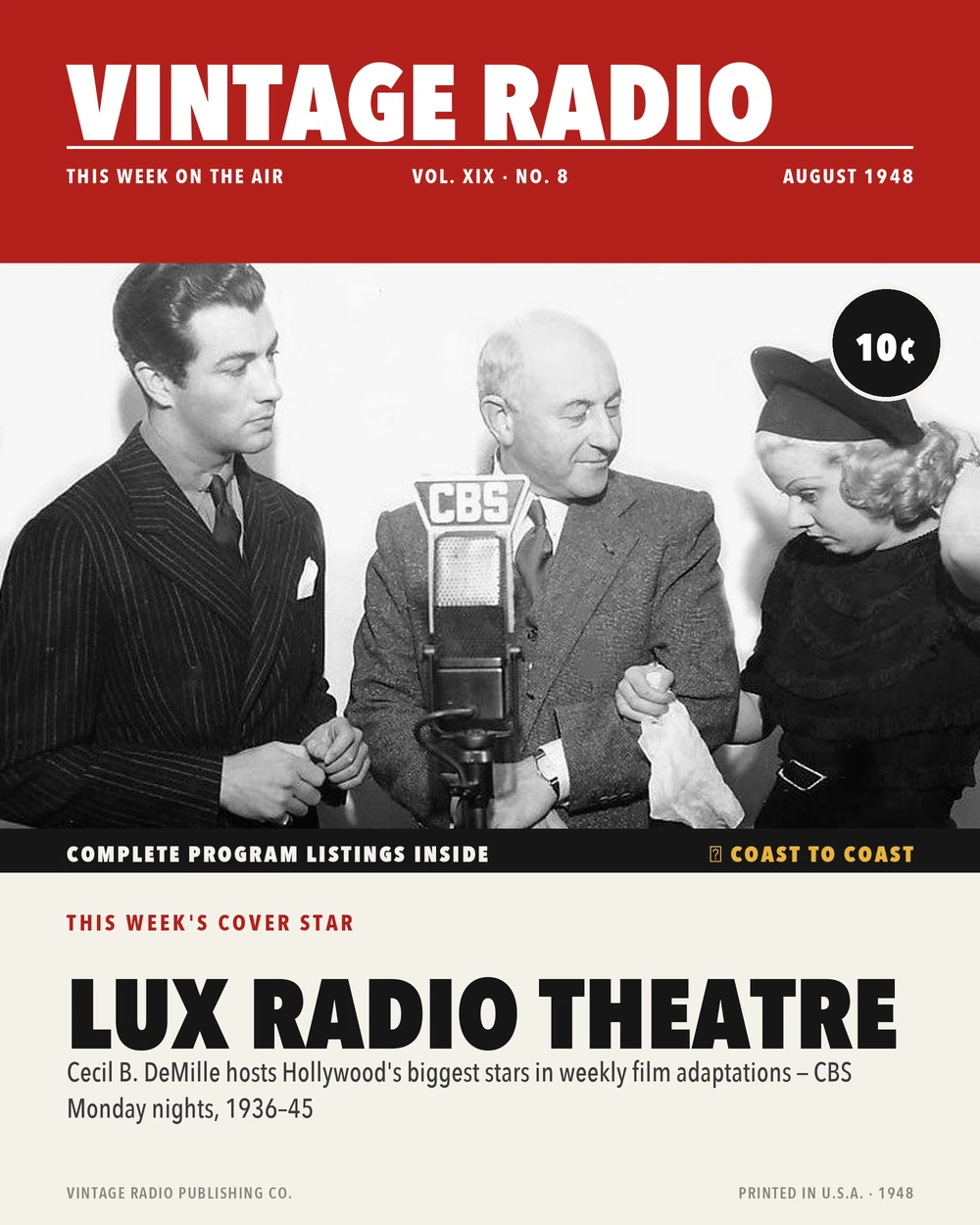
Lux Radio Theatre
The Most Important Dramatic Show in Radio
At its peak, an estimated 40 million people tuned in on Monday nights to hear the week's Lux Radio Theatre broadcast. That number is worth sitting with for a moment. Forty million listeners gathered around their sets to hear Clark Gable, Bette Davis, Spencer Tracy, Cary Grant, and scores of other major film stars perform live adaptations of well-known films — all in the service of selling a bar of soap. Whatever you think of the commercial machinery that produced it, the result was something radio had never seen before and hasn't seen since: a weekly drama hour that functioned simultaneously as a showcase for Hollywood talent, a promotional engine for the studio system, and, almost incidentally, as genuinely compelling radio theatre.
The show ran from October 1934 through June 1955 — more than twenty years on the air, spanning three networks. It started on the Blue Network as a Sunday afternoon Broadway anthology out of New York, moved to CBS in 1935, relocated to Hollywood in June 1936, and closed out its run on NBC in the spring of 1955. Lever Brothers sponsored the entire run, promoting Lux Soap from first broadcast to last. Few radio programs matched its longevity, its budget, its audience, or its roster of talent.
How a Near-Cancellation Built a Hit
The show that became radio's landmark drama started life in shakier shape than its reputation suggests. The original concept was straightforward enough: buy the rights to a respected Broadway play, hire the biggest available stage names, and broadcast the result on Sunday afternoons. The first broadcast, on October 14, 1934, was Seventh Heaven starring Miriam Hopkins. Early productions brought in genuine theatrical talent — Helen Hayes in What Every Woman Knows, Ethel Barrymore in Mrs. Dane's Defense — and the approach had a certain dignity to it. But it wasn't working well enough.
The New York-era show also looked different in ways that the Hollywood era would soon erase. The host was not a real public figure but a fictional persona: "Douglass Garrick," played first by John Anthony from the October 1934 premiere through mid-1935, then by Albert Hayes through May 1936. Each broadcast featured a scripted session in which Garrick chatted with the lead actors — the format DeMille would later inherit, but with an invented character standing in for a celebrity. The Lux Soap commercials, meanwhile, were delivered by another fictional creation: Peggy Winthrop, played by actress Doris Dagmar. The show in its New York incarnation was a stage-play anthology with a layer of fictional dressing on top, and the entire arrangement would shortly be replaced.
The problem was competition. Variety programs like The Rudy Vallee Hour and Shell Chateau were paying more money and making fewer demands on major performers. Landing a name like Leslie Howard required one Lux scout to physically grab the actor's suitcases and steer him through a gauntlet of competing agents to a waiting cab, on the theory that a man will always follow his luggage. By 1935 the show's ratings had dropped four points and the program was facing possible cancellation.
Danny Danker, an executive at J. Walter Thompson — the advertising agency handling the Lever Brothers account — was handed the task of rescuing it. His prescription was radical: abandon the Broadway stage-play concept entirely, move the production to Hollywood, hire major film stars instead of stage actors, adapt commercially successful motion pictures instead of theatrical plays, and spend whatever it took to do it right. It was Danker's overhaul that transformed Lux into the program history remembers.
The show moved to Hollywood in June 1936, slightly ahead of what Radio Guide would later describe as a mass migration of talent westward — within a little over a year of the Lux move, roughly 90 percent of what Radio Guide called "big-time personality programs" were broadcasting from California. The first Hollywood broadcast cost a reported $17,000, which worked out to approximately $300 a minute. Of that total, $5,000 went to Marlene Dietrich and $3,500 to Clark Gable. A top star appearing on Lux could take home as much as $5,000 for a single 60-minute broadcast. The show had found its formula.
Cecil B. DeMille and the Voice of Hollywood
No element defined the classic Lux Radio Theatre more completely than Cecil B. DeMille. He stepped in as host on June 1, 1936, with the first Hollywood broadcast — an adaptation of Morocco in which Clark Gable took over Gary Cooper's film role and Marlene Dietrich reprised her own. His tenure lasted until January 22, 1945. For those nine years, his voice — authoritative, theatrical, just slightly larger than life — was the show's signature. His opening line, "Greetings from Hollywood, ladies and gentlemen," became one of the most recognized phrases in American broadcasting. His sign-off, "This is Cecil B. DeMille saying goodnight from Holly—wood!" was a weekly ritual for millions of listeners. Tune In magazine wrote in 1943 that DeMille's opening almost sounded like "This is God, speaking from heaven." Whether that reads as admiration or gentle mockery probably depends on how you feel about Cecil B. DeMille.
The second Hollywood broadcast, on June 8, 1936, was The Thin Man with William Powell and Myrna Loy reprising their film roles (the dog Asta got a credit too). During that broadcast, DeMille turned to the studio audience and interviewed silent-screen legend Theda Bara, who was seated among the listeners — an interview that turns out to be the only surviving audio recording of Bara's voice. She used the moment to announce a film comeback that never materialized. The episode captures something essential about what Lux had become: not just a drama broadcast but a kind of weekly Hollywood event, where the audience itself contained the famous.
DeMille was paid $2,000 a week for the role. His actual duties were narrower than his billing suggested — DeMille was listed as producer and sometimes as director, but his real function was hosting: the theatrical opening, the post-play chat with the evening's stars about their current projects, and the Lux Soap plug at the end, which featured actresses cheerfully noting how soft the soap left their complexions. The actual directing was handled by a series of production professionals. But DeMille brought something the show needed beyond mere competence — an aura, a sense of occasion, and a genuine engagement with the work. In 1938 he said, "I wouldn't take a million dollars for the experience I've had in radio," and there's little reason to doubt him.
His departure was abrupt and entirely self-inflicted. The American Federation of Radio Artists had levied a one-dollar assessment against each of its members to build a war chest to fight Proposition 12, a California ballot measure that would have allowed workers to hold radio jobs without union membership. DeMille refused to pay the dollar — not out of opposition to labor unions in general, he insisted, but on principle, framing it as a matter of individual freedom. AFRA set deadlines, extended them, and ultimately stood firm. DeMille hosted his last Lux broadcast on January 22, 1945, and never came back. For the rest of 1945, a rotation of guest hosts filled in, including Lionel Barrymore, Walter Huston, William Keighley, Mark Hellinger, Brian Aherne, and Irving Pichel. Director William Keighley was given the permanent hosting job in the fall of 1945 and held it until 1952, when Irving Cummings took over for the final three years.
DeMille's physical commitment to the show was, on at least one occasion, extraordinary. After recovering from surgery, he performed against his doctor's orders, arriving at the Music Box Theater by ambulance and delivering his lines from a stretcher. Whatever his limitations as a broadcaster, the man was not lacking in dedication.
The Machine Behind the Broadcast
The Music Box Theater on Hollywood Boulevard, just off Vine Street, seated more than a thousand people and filled to capacity every week. At least fifty people were required for each broadcast, with often twenty or more speaking parts. The production week began on Thursday with a table reading of the script. Friday brought serious rehearsals — a two-hour session at noon, a lunch break at two, more readings through the afternoon. Sound effects were incorporated on Saturday. Sunday brought in the orchestra. Monday saw two dress rehearsals: the first at 10 a.m., recorded on transcription discs so the director could hear the show as the audience would; the final dress at 7:30 p.m. The live broadcast went out at 9. It was a five-day operation, every week, for most of two decades.
The orchestra under Louis Silvers numbered 25 players. Robert Armbruster conducted in 1936; Silvers led the ensemble until approximately 1951, when Rudy Schrager took over. The announcing duties cycled through Melville Ruick (from the first Hollywood broadcast), John Milton Kennedy (for most of the 1940s), and Ken Carpenter in later years. Writers George Wells and Sanford Barnett shaped the adaptations. Sound effects were handled by Max Uhlig, David Light, Walter Pierson, and Charlie Forsyth — the last of whom traveled during summer breaks with a specially equipped sound vehicle to record authentic location sounds, and who developed manual effects precise enough to make a briefcase latch sound exactly like a car door clicking shut.
The supporting cast, mostly radio professionals, provided the texture that made the productions work around the edges of the star performances. Among them were Frank Nelson, Earle Ross, Lou Merrill, Margaret Brayton, Florence Lake, Bill Johnstone, and Jeff Chandler — the last appearing in supporting roles before his film career took off. One production note from May 24, 1948, captures the casual professionalism of the radio regulars: when Burt Lancaster arrived late for the broadcast of I Walk Alone, director Fred MacKaye immediately reassigned Lancaster's part to bit player Ira Grossel and took Grossel's own part himself. Few listeners noticed. Grossel later became a star under the name Jeff Chandler.
Stars Under Pressure
Big film stars were not always natural radio performers, and the Lux production team spent considerable energy managing them. Director Frank Woodruff, who held the position until approximately 1943, was described in Radio Mirror in 1937 as "a miracle worker with headstrong stars" who "cracks the whip over filmdom's pets and makes them like it." The show's files, and the memories of the people who worked on it, are full of stories that illustrate both the anxiety that radio could produce in otherwise confident performers and the diplomacy required to get a finished broadcast out the door.
Ruby Keeler admitted to terror before her first Lux appearance. Jean Harlow was badly frightened by the microphone. Joan Crawford's hands shook so violently during Sunday rehearsals for Chained that she couldn't hold her script. When Lily Pons became so distressed that the production was in jeopardy, Woodruff arranged to have her fiancé, conductor Andre Kostelanetz, flown in from New York; Kostelanetz took over the baton for the final dress rehearsal and the broadcast itself. Grace Moore, a Metropolitan Opera prima donna who arrived with what sounded like expectations of temperament, actually only wanted a stick of gum, explaining that her knees were "knocking together like castanets."
Woodruff's confrontations with uncooperative stars became something of a department legend. Marlene Dietrich announced there would be no dress rehearsal because she was "not in the mood." Woodruff told her "we haven't got time to wait for moods here" and the rehearsal went forward. Claudette Colbert insisted on cutting a line Woodruff considered essential; he kept it in the adaptation. Ginger Rogers hated every word of her script but was coaxed through it. Errol Flynn arrived in the middle of a heated argument with his wife Lili Damita; the quarrel continued until Woodruff lost his patience, producing what Flynn's costar Olivia de Havilland recalled as an eruption she spent nights trying to replicate in front of her mirror. Fred MacKaye, who succeeded Woodruff around 1943, had himself appeared in Lux supporting roles before taking the director's chair, which gave him a particular understanding of what performers were going through.
The May 31, 1937 broadcast of The Plainsman came close to not happening at all when both Gary Cooper and Jean Arthur came down with the flu at the last minute. Arthur performed while weak and feverish. Fredric March was brought in to replace Cooper and stayed up through the night before the broadcast working on a western dialect he'd never used.
The Record It Ran Up
By the time the numbers were tallied near the end of the run, Lux had used an estimated 52,000 pages of script, 496 stars, 1,467 supporting players, 18,667 music cues, and 22,667 sound effects. Fred MacMurray made the most appearances of any star: 26 roles. Loretta Young appeared 25 times. Claudette Colbert made 24 appearances, Barbara Stanwyck 23, Cary Grant 22, Don Ameche 21, and Brian Aherne, Ray Milland, and George Brent each appeared 20 times. The show launched into radio's top ten after the Hollywood move and stayed there for most of its run.
The productions that survive give a clear picture of what the show was at its best. It Happened One Night, with Clark Gable and Claudette Colbert, aired March 20, 1939. Dark Victory, with Bette Davis and Spencer Tracy, aired January 8, 1940. National Velvet, with a young Elizabeth Taylor and Mickey Rooney, aired February 3, 1947. All About Eve, with Davis, Anne Baxter, and Gary Merrill, aired October 1, 1951. The African Queen aired December 15, 1952 — with Humphrey Bogart and Greer Garson filling the roles Bogart and Katharine Hepburn had played on screen.
The casting could be more flexible still when original stars were unavailable. The Lux Casablanca was mounted with Alan Ladd and Hedy Lamarr in the roles Bogart and Bergman had played on film. The October 18, 1944 broadcast of Suspicion cast William Powell in Cary Grant's part and Olivia de Havilland in the role her sister Joan Fontaine had played. When the originals could be had, they were: James Stewart and Donna Reed both reprised their roles in the March 10, 1947 broadcast of It's a Wonderful Life. Several hundred broadcasts survive in various sound quality, including transcription recordings of dress rehearsals that occasionally capture backstage exchanges — the action stopped, stars and booth personnel working through problems in real time.
In 1944 Lux received a Peabody Award for Outstanding Entertainment in Drama, presented as a joint award with An Open Letter to the American People, both CBS presentations. The citation noted that Lux, "produced by Cecil B. DeMille, received more listening-post votes than any other program in this category" — recognition that came near the end of DeMille's tenure and treated him, accurately or not, as the program's defining creative figure.
The Long Decline
The slide from peak began when William Keighley left the host's chair in 1952. His replacement, Irving Cummings, was a capable broadcaster but could not recover the show's earlier dominance, and Lever Brothers was by then increasingly focused on its television investments. The 1953 summer replacement run illustrates how dramatically the show's circumstances had changed. Lux Summer Theatre ran fourteen episodes between June 1 and August 31, 1953, directed and produced by Norman Macdonnell — then running Gunsmoke — with three original scripts from writer Kathleen Hite and one adaptation from John Meston. The per-episode budget was $4,250, a fraction of the $17,000 the first Hollywood broadcast had cost in 1936. Each episode carried only one major star (Joseph Cotten, Anne Baxter, and Fred MacMurray were among them), with Gunsmoke repertory players like Parley Baer filling out the supporting roles. The program was produced as a studio broadcast, without the live audience that had been part of the Lux experience for nearly two decades. The contrast with the show's peak production values is unmistakable.
The Armed Forces Radio Service had its own version of the show in those later years, retitled Hollywood Radio Theatre and hosted by Don Wilson — best known as the announcer on The Jack Benny Program. The final Lux broadcast aired June 7, 1955. The show had moved to NBC for its last season — still on Tuesdays at 9, still from Hollywood, still sponsored by Lux Soap. By then television had already changed the landscape that had made Lux Radio Theatre possible. But for nearly two decades, on Monday nights, it was the place where Hollywood came to the radio audience.